“Two years after the pogrom of 7 October 2023 against Israeli civilians, we are confronted with a bitter reality”, says Elio Adler, Chairman of the Board of WerteInitiative e.V. “Antisemitism is at the centre of German society and is politically connectable. And it is radical, networked and dangerous. The threat to Jews must no longer be presented as a perceived threat – it is real.”
Current figures prove that it is. Attacks on Jewish men and women can by now be described as a sad and normalised worldwide trend.
The Bundesverband RIAS has now presented a report which shows with shattering clarity the dimensions of antisemitic agitation in Germany, which increasingly culminates in violence. And it substantiates what Jewish men and women have been experiencing and communicating for two years – but which increasingly goes unheard, is ignored and brushed aside. The report systematically analyses antisemitic incidents in the political sphere after the Hamas terrorist attack on Israel on 7 October 2023. The findings are alarming:
- Political antisemitism is not a fringe phenomenon. It becomes visible in political parties, trade unions, universities and civil society organisations.
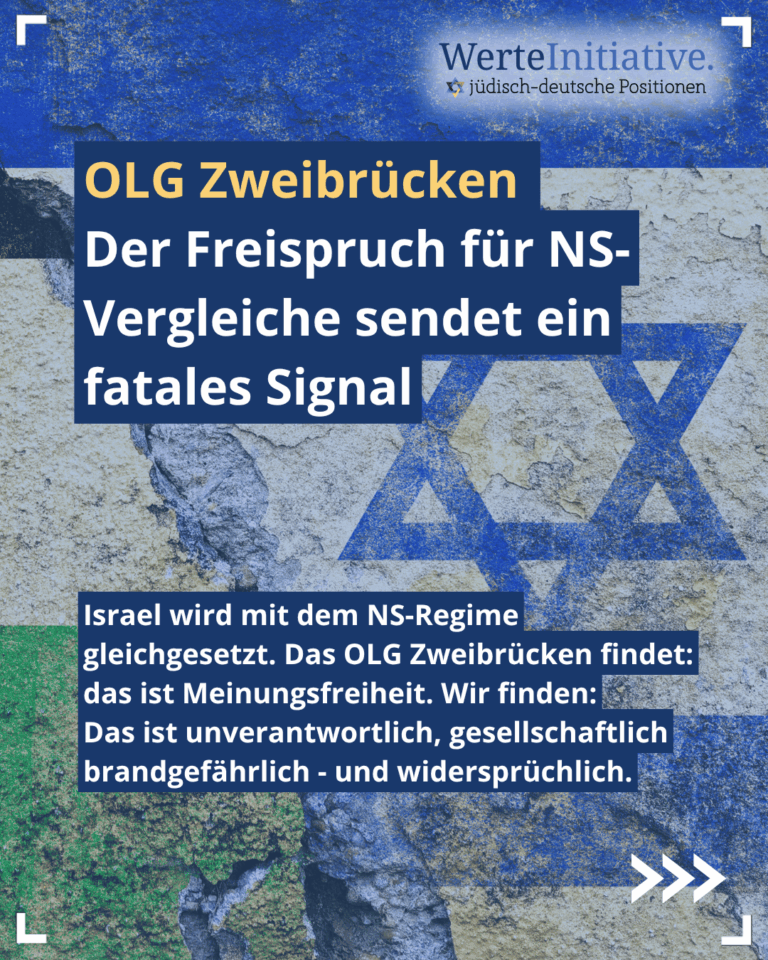
- Anti-Zionism increasingly serves as a cloak for Jew-hatred. Israel is demonised, delegitimised and equated with the Shoah.
- The terrorist attack of 7 October 2023 is widely relativised or justified. Perpetrator-victim reversal is also articulated in political contexts.
- Jewish perspectives are systematically ignored or discredited. Particularly affected: Jewish students and Jewish figures in public life.
- The removal of boundaries around antisemitism takes place through academic, cultural and activist spaces. In this, ostensible human rights narratives are instrumentalised in order to legitimise hatred of the Jewish state.
The Bundesamt für Verfassungsschutz likewise documents that the Hamas terrorist attack of 7 October 2023 and the continuing escalation in the Middle East have massively worsened the security situation in Germany. Antisemitism and hostility towards Israel act as an ideological link between different extremist milieus – from Islamists through pro-Palestinian extremists to parts of the left-wing and right-wing scene. Security authorities are uncovering plans for attacks on Jewish and Israeli institutions ever more frequently, while antisemitic narratives are widely disseminated on social media and at demonstrations. Iranian proxies such as Hamas and Hezbollah, Islamist propaganda and transnational networks contribute to radicalisation and pose an acute threat to Jewish life in Germany.
Two years after 7 October: an alarming record
Both RIAS and the Verfassungsschutz show that antisemitism in Germany has not only become loud and visible – it is politically connectable, networked and radical. And not only at the margins, but in the middle of civil society, academic and political spaces.
What is particularly appalling is how openly hatred of Israel is used as a cloak for hostility towards Jews: demonisation disguised as “criticism of Israel”, perpetrator-victim reversal after 7 October, relativisations of the Shoah and delegitimisations of Jewish self-defence run through the accumulating incidents like a common thread. It is no longer only extremist fringes, but self-appointed human rights organisations, cultural figures, university lecturers and politicians who fuel this discourse – often under the cloak of humanity.
The message to Jewish men and women in Germany is unambiguous: your pain does not count. Your safety is secondary. Your existence is negotiable. That is not only morally reprehensible and unworthy of a democracy – it is dangerous. For social cohesion, for democratic culture, for the internal peace of this country.
We therefore demand of politicians, with urgent reference to the recently presented 5-point plan against antisemitism:
- A consistent naming of anti-Zionism as a modern form of antisemitism
- A political ostracism of antisemitic narratives – also and precisely when they come in the guise of criticism of Israel.
- The discontinuation of public funding for organisations that spread openly or structurally antisemitic content, often under the cloak of human rights.
- A clear political signal: the safety of Jewish life and Israel’s right to exist are not negotiable.
- To effectively prevent the influence of foreign actors such as Iran and Hamas on German soil.
From universities and civil society actors:
- Clear red lines towards hatred of Israel, relativisation of the Shoah and antisemitic agitation.
- Active protection concepts and serious inclusion of Jewish perspectives – especially in the university context.
- A public examination of their own blind spots with regard to antisemitism.
The current reports by RIAS and the Verfassungsschutz have long since ceased to be warning signs. They are a stocktaking of a state of affairs that we must no longer accept.
“Anyone who is serious about ‘never again’ must take a position now – even if it is uncomfortable”, says Adler. “We must no longer merely analyse antisemitism, we must fight it. Clearly. Consistently. Together. Now!”
Further links:
Verfassungsschutz
https://www.verfassungsschutz.de/SharedDocs/pressemitteilungen/DE/2025/pressemitteilung-2025-10-06-jahrestag-hamas.html
RIAS-Bericht
https://report-antisemitism.de/documents/25-10-06_BVRIAS_Politischer-Antisemitismus-7-Oktober.pdf
5-point plan of the D-A-CH Bündnis gegen Antisemitismus
Petition · Nie wieder heißt JETZT – Fünf Punkte gegen Antisemitismus! – Deutschland · Change.org