
Christian Anti-Judaism: Ancient Images, Living Tradition
At a Glance
Christian anti-Judaism arose out of the young Church’s demarcation of itself from Judaism. Early Christian Church Fathers described Jews as “blind”, “obdurate” or even as “murderers of God”. These interpretations shaped theology, art and liturgy over many centuries and laid the foundation for a religiously legitimised hostility.
Medieval traditions:
In the Middle Ages, Jews were portrayed in Passion plays, sermons and church art as enemies of Christ. So-called supersessionism taught that Christianity had superseded “old Israel” – an idea that legitimised social exclusion, pogroms and stereotypical images of the “evil Jew”.
The Reformation and Luther’s legacy:
The Reformation, too, marked no break but a radicalisation: in his late writings Martin Luther formulated extreme anti-Jewish agitation that paved the way for later forms of modern antisemitism. His formulations found an ideological continuation in the National Socialist motto “The Jews are our misfortune”.
National Socialist instrumentalisation:
National Socialism took up old Christian images of the enemy such as the “murderer of God” or the “Antichrist” and filled them with new, political meaning. Hitler styled himself as a messianic bringer of salvation in the struggle against a supposedly “evil” Jewry. Religious symbolism and a racist ideology of violence thus fused into a deadly synthesis.
A theological break and enduring patterns:
With the Catholic declaration “Nostra Aetate” (1965) and the “Wort zur Judenfrage” of the EKD (1950) respectively, both churches officially rejected the thesis of collective guilt and prepared the ground for recognising the common root of Christianity and Judaism. Yet despite theological corrections, anti-Jewish images and patterns of speech live on in liturgy, art and cultural memory.
Survival in the present:
Antichrist motifs and demonising stereotypes live on to this day. The mystical-Orthodox Russian ideologue Alexander Dugin, for example, describes the West as the “realm of the Antichrist”. Similar patterns are also found in Islamic antisemitism, where religious demonisation merges with political enemy images, or in antisemitic conspiracy myths.
Christian Anti-Judaism
Christian anti-Judaism is one of the oldest and most influential roots of antisemitism in Europe. Its origins reach back to the early period of Christianity, when the young Church defined itself in demarcation from Judaism. Anti-Jewish polemics are found as early as the writings of the Church Fathers: Jews were called “blind” because they did not recognise Jesus as the Messiah, or “murderers of God” who bore the guilt for the death of Christ. These notions shaped theology, liturgy and art over centuries and created a cultural pattern of interpretation that portrayed Jewish women and men as morally inferior and religiously misguided.
In the Middle Ages this tradition became entrenched. In Passion plays, sermons and church art the Jewish population was stylised into a symbolic figure of evil – often in physically distorted, caricatured depictions. The Church taught that the “new Israel”, that is Christianity, had superseded “old Israel”: a concept of supersessionism that denied Jews any salvific significance of their own. This laid the basis for systematic discrimination, social exclusion and recurrent pogroms.

The so-called “Judensau” (“Jews’ sow”, a medieval anti-Jewish sculpture) on the Stadtkirche in Wittenberg
Photo: Sean Gallup/Getty Images[/caption]
After the Reformation, too, anti-Jewish interpretations remained formative. Martin Luther, for instance, resorted in his late writings to fierce agitation against Jews – his pamphlets On the Jews and Their Lies (1543) and Vom Schem Hamphoras spread the notion that Jews were enemies of God and corrupters of Christendom. Luther’s words had after-effects into the twentieth century: the National Socialist dictum “The Jews are our misfortune”, which for decades served as the masthead of the hate paper Der Stürmer, takes up this Lutheran tradition almost verbatim.
Under National Socialism, Christian anti-Jewish motifs were deliberately reinterpreted and deployed as propaganda. Centuries-old notions of the “Jewish murderer of God” and of the “Antichrist” flowed into the antisemitic worldview: the Jew was regarded as the embodiment of evil, who had betrayed Christ and with him “true” humanity. Within this framework of interpretation Adolf Hitler staged himself as a messianic, redeeming figure, as a “saviour” and “fighter against the Jewish Antichrist” – a sacralised self-stylisation that mobilised religious emotions politically and made the extermination of the Jews appear as a supposed “mission of salvation”.
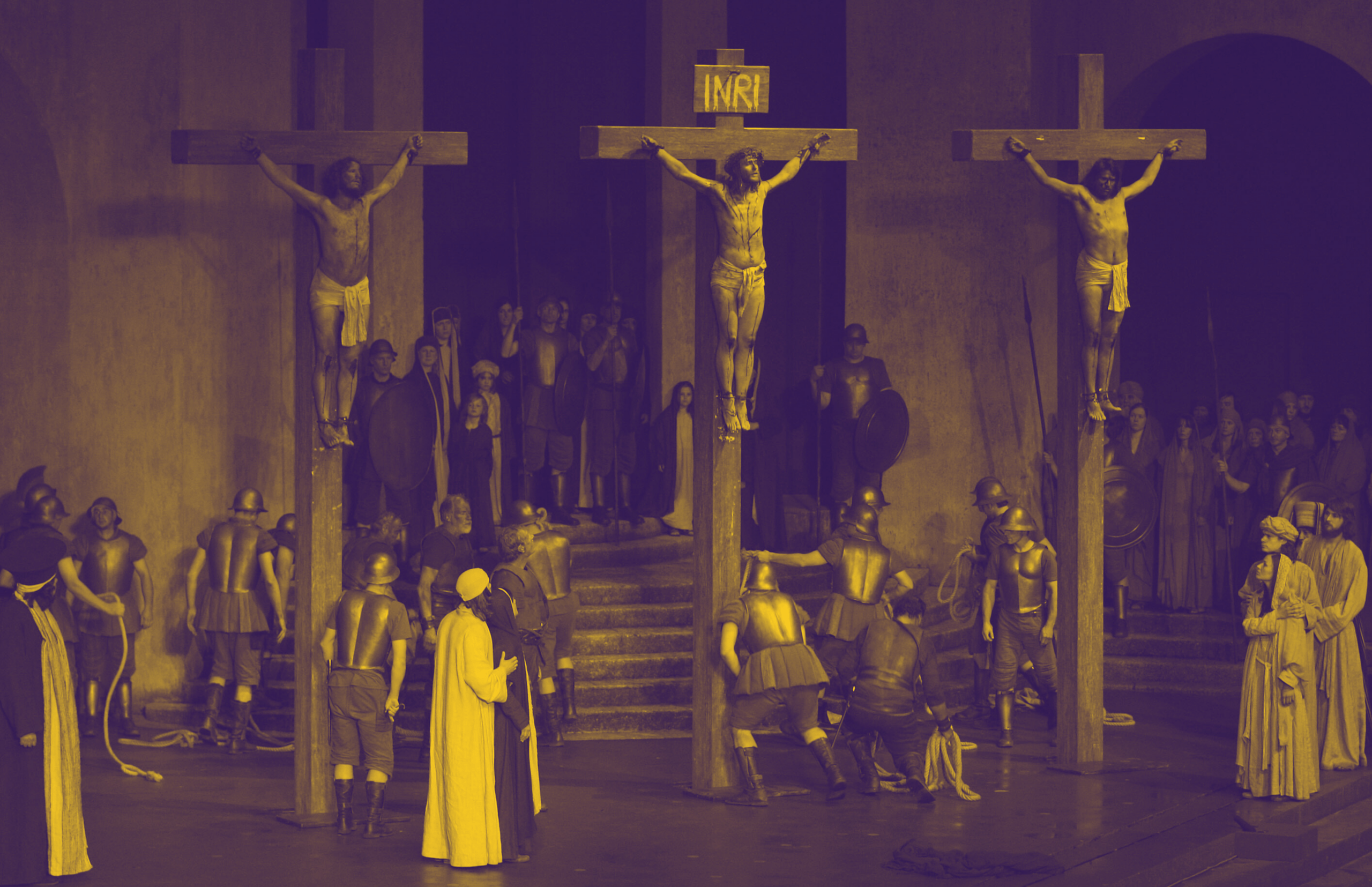
With the Second Vatican Council a theological break began: in the declaration Nostra Aetate (1965) the Catholic Church expressly acknowledged the common root with Judaism and rejected the thesis of collective guilt. Many Protestant churches, too, acknowledge this responsibility today. Nevertheless the old patterns live on – in religious symbolism, in language and in popular depictions, for example in Passion plays in which Jewish figures still appear as the guilty party or as adversaries.
Beyond this, the motif of the “Jewishly connoted Antichrist” lives on to this day in conspiracy myths. It combines religious and political images of the enemy that portray Jews as the embodiment of evil. In the present, the Russian ideologue Alexander Dugin, for instance, draws on such symbolism when he describes the West as the “realm of the Antichrist” – a pattern that transfers old Christian stereotypes into geopolitical myths. The motif is also a central element in Islamic antisemitism, where it is combined with conspiracy narratives.
Christian anti-Judaism is thus not only a historical legacy but a living line of tradition whose motifs continue to have an effect in modern forms of antisemitism to this day. Coming to terms with it requires more than religious self-criticism: it demands an awareness that the demonisation of Judaism is deeply anchored in European cultural history – and that every generation bears a responsibility to recognise and overcome these images.
Christian Motifs of Anti-Judaism
One of the most consequential myths of the Christian tradition is the accusation that the Jews killed the “Son of God”. Since late antiquity, many sermons held the Jewish people to be collectively guilty of the death of Christ – an idea that served to legitimise discrimination and violence. This charge runs through medieval liturgies and formed the basis for pogroms at Easter, when the Passion of Christ was performed. Only the Second Vatican Council (1965) officially rejected this “collective guilt” and stressed that the death of Jesus is not to be blamed on the Jewish people.
The Blood Libel
From the twelfth century onwards, the notion spread in Europe that Jews abducted and murdered Christian children in order to use their blood for religious rituals.

The “Martyrdom of St Simon of Trent”, a depiction of the antisemitic blood libel.
Photo: The Print Collector/Getty Images[/caption]
This lie – the so-called
blood libel
– served as justification for pogroms and public executions, for example in Norwich in England (1144), in Trent (1475) or in Sandomierz in Poland. The myth combined religious demonisation with social paranoia and turned Jews into demonic adversaries of Christendom.
Even today the narrative resurfaces in modern conspiracy myths – in the form of the “children’s blood” motif in QAnon or the antisemitic narrative of “Israel the child murderer”.
The Figure of the “Wandering Jew”
The legend of the “Wandering Jew” arose in the late Middle Ages: a Jew said to have mocked Jesus on the way to the crucifixion would, as a punishment, roam the world restlessly until the return of Christ. This motif combines a religious attribution of guilt with the idea of an endless, restless existence – a symbol of an allegedly homeless, “unredeemed” Jewry.
In literature, art and later in the National Socialist propaganda film
The Eternal Jew
(1940) the figure was staged as the epitome of the “alien, subversive Jew” – a direct bridge from religious to racist antisemitism.
Passion Plays and the “Antichrist”
Passion plays emerged in the Middle Ages as religious dramas in which the story of Jesus’s suffering was depicted. Jews were frequently shown in them as cruel, scheming figures – with pointed noses, dark clothing or purses as stereotypical markers. Many of these productions, for example in Oberammergau, reproduced for centuries the image of the “evil Jew” that was deeply rooted in Christian popular belief.
In addition there is the figure of the
“Antichrist”
, which in theological and popular narratives was frequently coded as Jewish – as a symbol of the ultimate adversary of Christ. In the present, ideologues such as Alexander Dugin take up this motif again in order to charge modern images of the enemy – the “decadent West” or “globalism” – with religious meaning.
These motifs – deicide, ritual murder, the Wandering Jew, Passion plays and the Antichrist – form the ideological framework of Christian anti-Judaism. Over centuries they created an emotional and cultural matrix in which Jewish women and men were understood not as human beings among human beings but as eternal adversaries – a perception whose after-effects are visible to this day.
Current Examples
Debates about contextualising, removing or reworking symbols and narratives carrying Christian anti-Jewish motifs arise again and again today. Examples are the anti-Jewish figure of the “Judensau” (“Jews’ sow”) on the Stadtkirche in Wittenberg, the Oberammergau Passion play, which has been revised since the 1990s in a manner critical of antisemitism, or the pejorative use of the word “Pharisee” (originally the name of a Jewish reform movement, but used in the New Testament to designate opponents of Jesus and turned, through Christian interpretation, into a term for the archetype of hypocrisy).
In digital and conspiracy milieus the charge of “the murder of Christ”, for example, is taken up again, combined with blood libel myths and fantasies of Jewish power. The attribution of guilt “the Jews killed Jesus” appears combined with “the Jews control the media/finance”.
(in English)
A report by the Amadeu Antonio Stiftung, the EXPO Foundation and HOPE not hate analyses how antisemitic conspiracy narratives are spread on digital platforms, addressing in this context the myths of “ritual murder” and “the murder of Christ” (2021). PDF:
In far-right circles such as the Christian Identity Movement in the USA it is claimed that white Christians are the “true Israel”, while Jews are demonised as a false “old Israel” – this clearly ties in with Christian anti-Jewish patterns of interpretation (article by Eliza Marks for the Global Network on Extremism & Technology, 2023).
(in English)
Video
The video shows how Christian anti-Judaism shaped Europe’s thinking, art and culture over centuries – and why its motifs continue to have an effect in language, images and social ideas to this day. It makes clear that this deeply rooted tradition forms the cultural basis of modern antisemitism and reaches into our present.
Sources and Further Information
Here you will find further literature and projects on the topic. A study by the European Institute for Counter Terrorism and Conflict Prevention (EICTP) shows that anti-Jewish conspiracy narratives — among them Christian-influenced elements such as the idea of Jewish omnipotence or of “manipulative” influence — are still at work in current ideologies and are amplified by digitalisation, populism and globalised crises.
The joint research project “Christliche Signaturen des zeitgenössischen Antisemitismus” examines religious-Christian elements of antisemitism in historical and present-day manifestations as well as their transfer into media, educational and social contexts, and shows that configurations of Christian anti-Judaism are not merely historical but can be structurally linked to present-day antisemitic attitudes and practices.
Antisemitismus.wtf: Gott ist tot – und wer ist schuld? Die Legende vom Gottesmord.
Botsch, Gideon (2014). Von der Judenfeindschaft zum Antisemitismus. Ein historischer Überblick. In: Aus Politik und Zeitgeschichte. Bundeszentrale für politische Bildung.
Buchner, Bernd (2017): Schwieriges Erbe – Die evangelische Kirche und Luthers Judenhass.
Erb, Rainer (ed.) (1993): Die Legende vom Ritualmord: zur Geschichte der Blutbeschuldigung gegen Juden. Berlin: Metropol Verlag.
Grigat, Stephan (2025): Vom Antijudaismus zum Hass auf Israel. Interventionen zur Kritik des Antisemitismus. Schriften der Katholischen Hochschule Nordrhein-Westfalen. Verlag Barbara Budrich. Free PDF download:
Hoyer, Jessica: Glossary entry “Hostienfrevel” (desecration of the host). Glossar Antisemitismus of the Bundeszentrale für politische Bildung.
Luba, Arkadiusz (2018): Antisemitische „Fake News“: Die fürchterlichen Folgen der Ritualmordlegende. Contribution for Deutschlandfunk Kultur.
Tarach, Tilman (2022): Teuflische Allmacht: Über die verleugneten christlichen Wurzeln des modernen Antisemitismus und Antizionismus. Berlin/Freiburg: Edition Telok.
Töllner, Alex (2022): Von christlichem Antijudaismus im modernen Antisemitismus. Zeitschrift für Religion, Gesellschaft und Politik 6(1):1-21.
Wiese, Prof. Christian (2018): Antisemitismus in der Evangelischen Theologie und Kirche. Expert report for the second independent panel of experts on antisemitism.