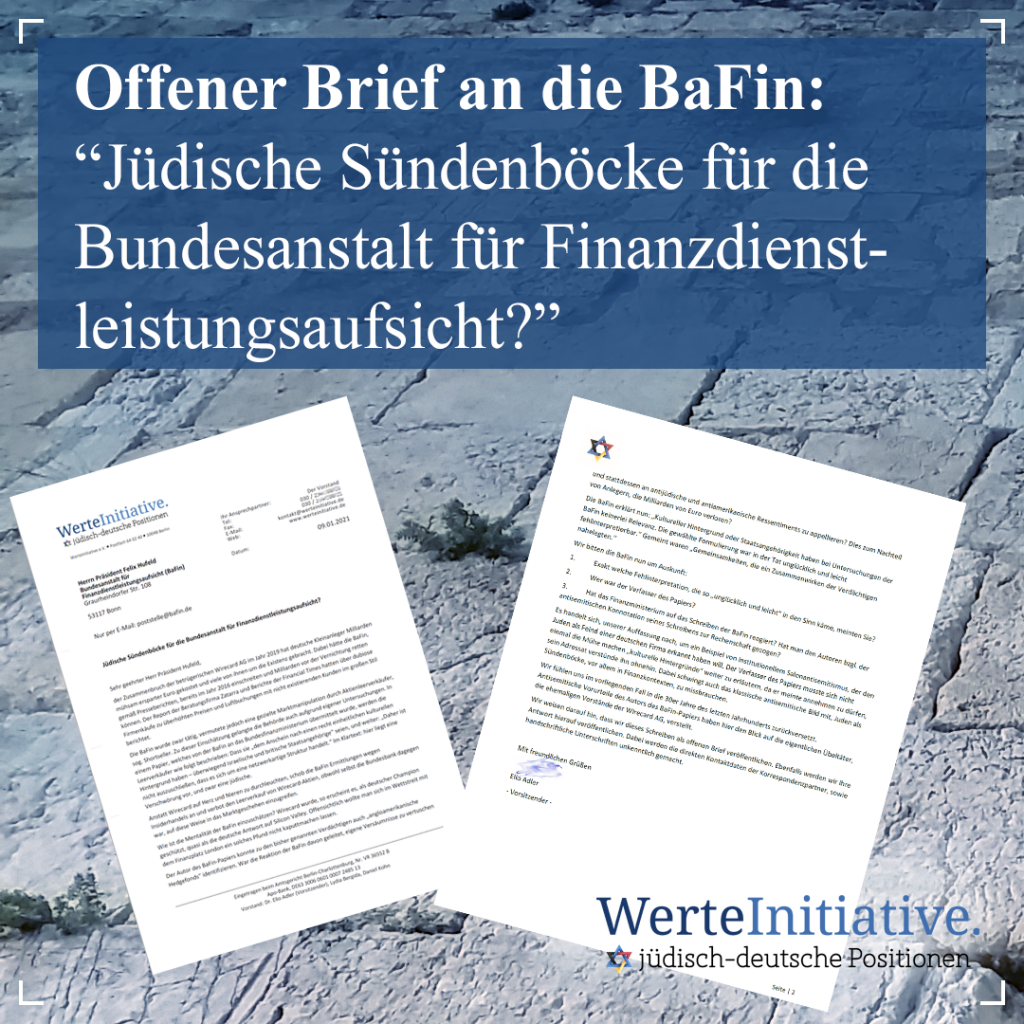
The BaFin had commented to the Federal Ministry of Finance regarding the Wirecard scandal. It did so, among other things, by means of a clearly antisemitically connoted choice of words. We therefore wrote to the president of the BaFin and asked for answers to our questions. Mr Hufeld, president of the BaFin, replied to our letter and apologised for the formulations.
A respectable apology from the BaFin. Thank you for the clarity and for taking responsibility.
The complete correspondence can be found here:
Dear President Hufeld,
the collapse of the fraudulent Wirecard AG in 2019 cost German small investors billions of laboriously saved euros and deprived many of them of their livelihoods. Yet, according to press reports, the BaFin could have intervened as early as 2016 and saved billions from destruction. The report by the consulting firm Zatarra and reports in the Financial Times had described dubious company purchases at inflated prices and fictitious bookings with non-existent customers on a large scale.
The BaFin did indeed take action, but suspected targeted market manipulation by short sellers of shares, so-called shortsellers. The authority arrived at this assessment also on the basis of its own investigations. In a paper which the BaFin transmitted to the Federal Ministry of Finance, the short sellers are described as follows: that they „apparently have a fairly uniform cultural background – predominantly Israeli and British nationals“, and further: „It therefore cannot be ruled out that this is a network-like structure.“ In plain language: there is a conspiracy here, and a Jewish one at that.
Instead of scrutinising Wirecard thoroughly from top to bottom, the BaFin set investigations for insider trading in motion and banned the short selling of Wirecard shares, although even the Bundesbank was against intervening in market events in this way.
How is the mentality of the BaFin to be assessed? Wirecard was, so it appears, protected as a German champion, virtually as the German answer to Silicon Valley. Evidently, in the competition with the financial centre of London, one did not want to let such an asset be ruined.
In addition to the suspects named so far, the author of the BaFin paper was also able to identify „Anglo-American hedge funds“. Was the BaFin’s reaction guided by the aim of covering up its own failures and instead appealing to anti-Jewish and anti-American resentments? And this to the detriment of investors who lost billions of euros?
The BaFin now declares: „Cultural background or nationality have no relevance whatsoever in BaFin investigations. The formulation chosen was indeed unfortunate and easily open to misinterpretation.“ What was meant were „commonalities which suggested that the suspects were acting together.“
We now ask the BaFin for information:
1. Exactly which misinterpretation, one that would come to mind so „unfortunately and easily“, did you mean?
2. Who was the author of the paper?
3. Did the Ministry of Finance react to the BaFin’s letter? Was the author held to account with regard to the antisemitic connotation of his letter?
In our view, this is an example of institutional drawing-room antisemitism which claims to have identified the Jew as the enemy of a German company. The author of the paper did not even have to take the trouble of explaining „cultural backgrounds“ any further, because he believed he could assume that his addressee would understand him anyway. Resonating in this is also the classic antisemitic image of misusing Jews as scapegoats, above all in financial contexts.
In the present case we feel transported back to the 1930s. Antisemitic prejudices on the part of the author of the BaFin paper have here obstructed the view of the actual wrongdoers, the former board members of Wirecard AG.
We point out that we are publishing this letter as an open letter. We shall likewise publish your reply to it. In doing so, the direct contact details of the correspondence partners, as well as handwritten signatures, will be made unrecognisable.
Yours sincerely
Elio Adler
– Chairman -Dear Dr Adler,
many thanks for your letter, in which you quite rightly criticise formulations in a letter from my authority dated 11 May 2016. I should like to take this as an occasion to apologise.
The formulations you quote and the reference to nationality are unacceptable and without doubt a grave lapse. Nationality and origin play no role in assessing the lawfulness of an action – and must not do so.
Please allow me to explain the background to the letter: we had received information from another European supervisory authority. It suggested possible concerted action in short selling, among other things because the persons involved used the same IT infrastructure. On the basis of these and further findings, supervisory measures were taken. The reference to the origin of those involved was entirely inappropriate in this context.
I have taken the incident as an occasion to urge all superiors and staff that our impartial and non-discriminatory conduct of office must also be reflected in the wording of our memos and letters, and I have asked for greater care and sensitivity in this respect.
I assure you that the Bundesanstalt für Finanzdienstleistungsaufsicht is committed to values such as tolerance and openness to the world and tolerates no discrimination and no antisemitism in its ranks. As a federal authority which is committed to the free democratic basic order and is represented in numerous international bodies, the BaFin must be above any doubt in this regard. The statements referred to above did not do justice to this claim. For that I sincerely apologise once again, also on behalf of my authority.
Yours sincerely
Hufeld