Conspiracy ideology: omnipotence and constant threat
At a glance
Antisemitism and conspiracy ideologies have been closely linked for centuries. Almost every major conspiracy narrative makes use of the image of a “secret Jewish power” that steers and controls things in the background.
The basic principle of conspiracy ideologies:
They explain complex crises and developments as the deliberate machinations of a small elite. Coincidence, social dynamics or ambiguity are screened out – everything appears to be deliberately steered. Evidence plays no role; counter-arguments are treated as part of the conspiracy.
Antisemitic patterns:
Jewish people are portrayed as powerful, sinister and manipulative. Typical of this is the simultaneity of omnipotence and threat – “the Jews” appear as overwhelmingly powerful and at the same time as a danger. Central to this is the myth of the “Jewish world conspiracy”, as in the
Protocols of the Elders of Zion
.
Modern manifestations:
Conspiracy narratives about a “global elite” that supposedly controls the media, financial systems or politics circulate on social media and in populist milieus. Antisemitic codes or symbols are often used to disguise such claims.
Impact and danger:
These narratives create a closed worldview that stokes fear, mistrust and hostility – and appears to explain complex problems simply. They provide relief by externalising blame – and at the same time legitimise denigration, hatred and violence. Time and again, antisemitic conspiracy ideologies have been the starting point for real attacks and acts of violence.
Conspiracy ideology: omnipotence and constant threat
Antisemitism and conspiracy ideology have been closely intertwined for centuries: hardly any conspiracy narrative manages without the image of an all-powerful Jewish power operating in secret.
Conspiracy ideologies are characterised by the fact that they interpret social events and crises not as the result of complex processes but as the result of the secret machinations of a conspiratorial elite. The claim is that a small, powerful group plans and manipulates “behind the scenes”, while broad sections of the population unwittingly bear the consequences. Such narratives are often easy to understand, emotionally charged and at the same time hard to refute – because counter-evidence is readily dismissed as part of the conspiracy.
In the context of antisemitism there is a further element: many of these conspiracy myths fall back on historical projections that have long associated Jewish people with excessive power, secret influence and subversive behaviour. One central myth is the “Jewish world conspiracy”, as the pamphlet
The Protocols of the Elders of Zion
propagated it.

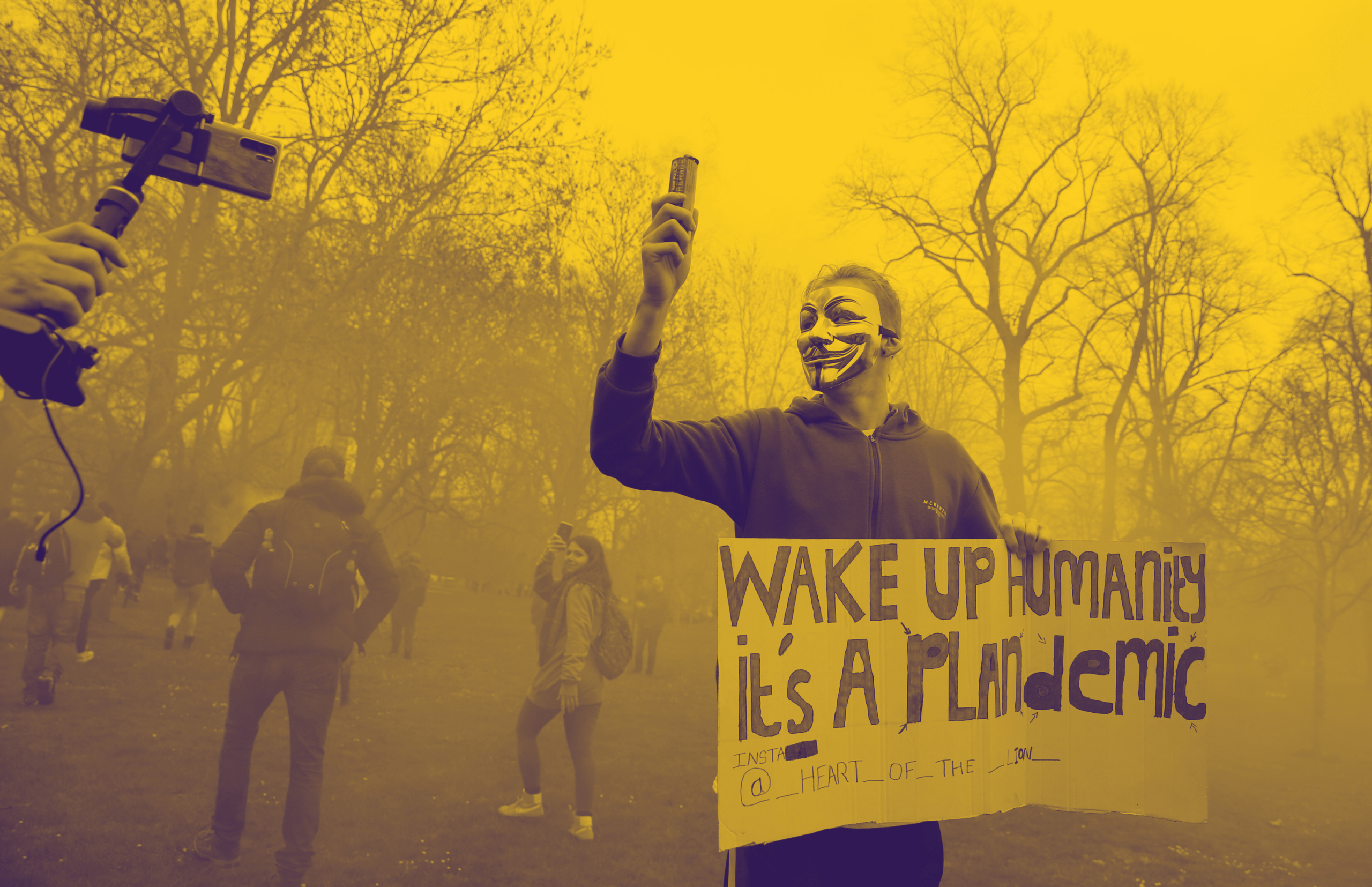
Conspiracy-ideological magazine “Compact” and “QAnon” badges at a demonstration by “Querdenker 711” in Berlin in 2020.
Photo: Sean Gallup/Getty Images[/caption]
On social media it is frequently claimed that a secret elite controls the media, the financial world or political processes – in part in direct connection with antisemitic symbolism or codes. These narratives do not merely serve to explain power relations; they also generate a constant sense of threat. Antisemitic conspiracy ideologies cast “the Jews” or “the Jewish” at once as all-powerful perpetrators and as an invisible, omnipresent danger said to threaten “the people”, “the true nation” or “the pure order”.
It is precisely this double structure of omnipotence and threat that makes antisemitic conspiracy narratives so potent: they supply a closed worldview in which every political, social or personal failure can be traced back to a hidden Jewish influence. The result is a paranoid system of interpretation that produces constant fear, mistrust and defensiveness – and at the same time offers relief, because it appears to explain complex problems simply. This emotionally charged construction of threat subsequently legitimises denigration, exclusion and violence.
It can also be observed that conspiracy ideologies do not remain marginal phenomena: they mobilise real fear, combine with other extremist ideologies and are in many cases the starting point for antisemitically motivated acts of violence. Examples such as crime scenes or attacks demonstrate the close connection between antisemitic conspiracy thinking and concrete violence.
The “Protocols of the Elders of Zion”
The
Protocols of the Elders of Zion
are one of the most consequential forgeries of the 20th century. The document was produced around 1903 in tsarist Russia by the secret police (Okhrana) and claims to record the minutes of secret meetings of Jewish “world conspirators”. The plot, in which rabbis meet in a Jewish cemetery to discuss their plans for world domination, gives readers the impression that they are learning about secret events at first hand, that they therefore belong to the enlightened, that they are in the know. In fact it is a plagiarism of French and German political satires, deliberately rewritten in antisemitic terms.
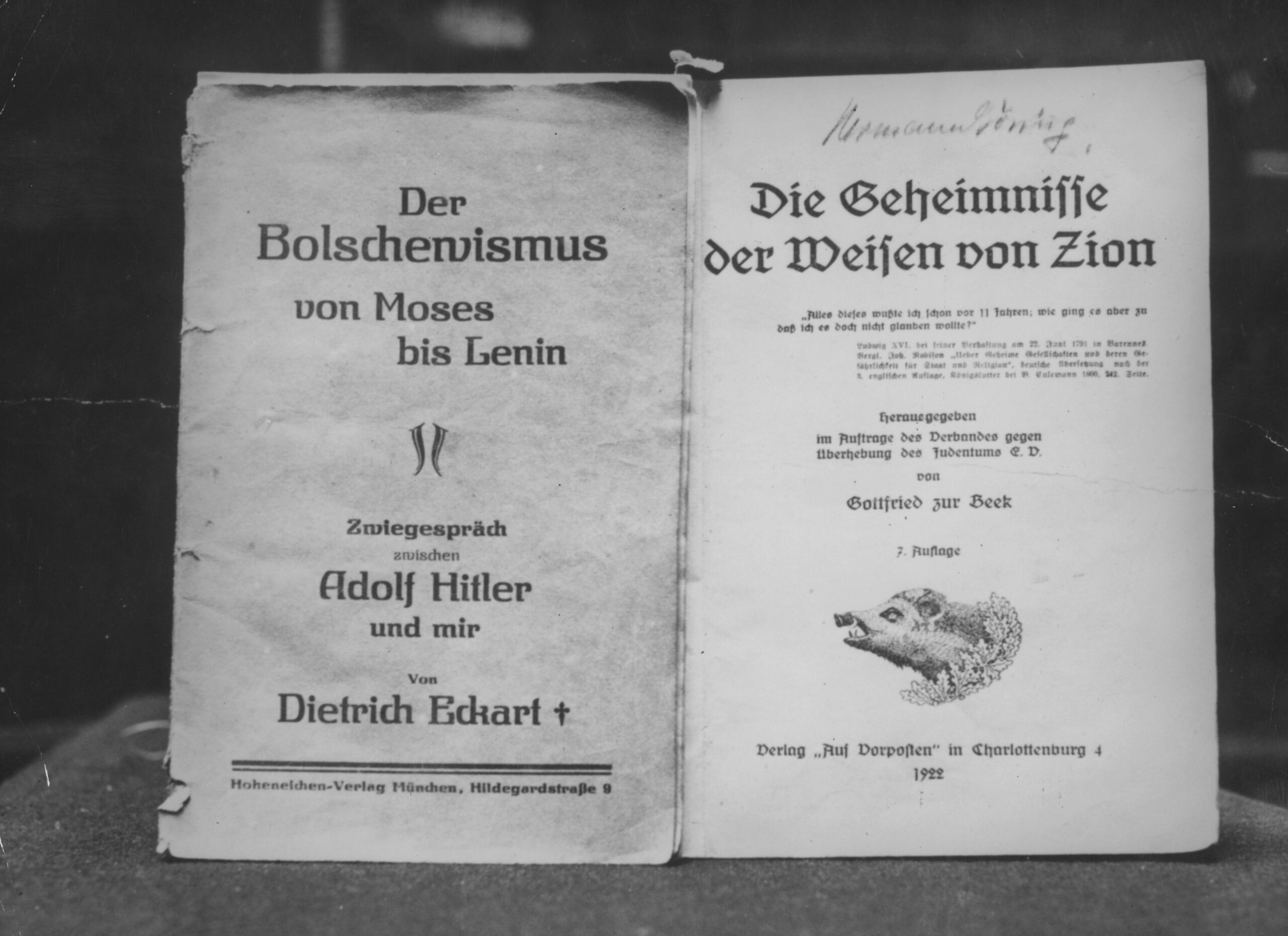
Antisemitic conspiracy-ideological writings by Dietrich Eckart. Picture: Hulton Archive[/caption]
Despite being exposed as a forgery at an early stage (among others by the
Times
in 1921), the
Protocols
spread worldwide in countless translations. They became the ideological foundation of modern antisemitic movements, served the National Socialists as “proof” of Jewish ambitions for power and are still used today in Islamist, far-right and conspiracy-ideological milieus.
In the digital age, too, they circulate in blogs, Telegram channels or YouTube videos — often in modernised language, but with the same narrative: “the Jews” are said to be behind globalisation, the financial world, the media or pandemics. In this way the
Protocols
continue to act to this day as a cultural code that links classic antisemitic stereotypes to contemporary topics.
The afterlife and continuing impact of the “Protocols of the Elders of Zion”
The industrialist Henry Ford regularly published extracts from and commentaries on the “Protocols” in the paper
The Dearborn Independent
.
His publications reached a circulation of more than 500,000 copies and spread the forgery widely among the American public.
1925–1945 – National Socialist propaganda
In the Nazi state the “Protocols” appeared as a “people’s edition” from the party publishing house Franz Eher Nachf. and were used in schools and in propaganda abroad – exported as far as Japan and South America. Hitler believed, or acted as though he believed, in the “Protocols” – regardless of their authenticity. In
Mein Kampf
(1925/26) he writes about the
Protocols
: “The best proof of the authenticity of these Protocols is the fact that what is written in them has come true and comes true daily.” For him it was not historical factuality that counted but the ideological “truth” they supposedly expressed.
1930s–1960s – dissemination in the Arab world
As early as 1938, Arabic translations of the “Protocols” were distributed at a conference in Cairo organised by the Muslim Brotherhood. After the founding of Israel, the “Protocols” spread on a mass scale in Arab countries.
An Egyptian school textbook, for example, presented them as genuine resolutions of the Zionist Congress in Basel. Sayyid Qutb and the Muslim Brotherhood also adopted and Islamised antisemitic elements of the text.
1988 – Hamas Charter
In its founding charter Hamas refers explicitly to the “Protocols”, which are described there as the “plan of the Zionists”. They served to give religious legitimacy to political antisemitism.
1990s – Russia and Eastern Europe
Nationalist movements such as Pamyat took up the “Protocols” once again.
They also circulated in anti-Zionist groups in the Middle East and shaped post-Soviet conspiracy narratives.
2000s – Islamist and state media productions
The Syrian television series “Ash-Shatat” (2003) depicts a global Jewish conspiracy modelled on the “Protocols”.
In Iran, state television (IRIB) produced series such as
“The Secret of Armageddon”
(2008) and
“Al Sameri wa Al Saher”
, which attribute to Jews control over the media and politics.
In some Arab school textbooks the “Protocols” are still presented today as “authentic documents”.
2010s to the present – global and digital circulation
US
neo-Nazi groups
such as the National Alliance, Stormfront, The Daily Stormer, Aryan Nations or Ku Klux Klan offshoots still distribute extracts or new editions of the
Protocols
online. In circles around the
“Nation of Islam”
the “Protocols” are described as a “mirror of truth” and Jews are portrayed, for example in the text
The Secret Relationship Between Blacks and Jews
as the masterminds behind the slave trade or the world of finance.
In
Greece
they were quoted in 2012 by a member of the party
Golden Dawn
in parliament. In
South America
and
Asia
, including Malaysia, they are sold openly at airports, for example.
The “Protocols” also circulate worldwide in conspiracy media, Telegram channels and online forums such as the 8chan/8kun forums, Telegram, Gab or Bitchute.
Current examples
Antisemitic conspiracy ideology adapts continually to current events – yet its patterns and images remain remarkably constant. The following four areas of phenomena show – with no claim to completeness – typical narratives that are currently circulating on social media and in public debate and that repeatedly repackage old antisemitic conspiracy myths. We make further examples and possible counter-speech available at
.
1) “Elite control & financial power” (Soros/Rothschild, “Great Reset”, WEF)
puppet strings, octopus, dollar sign with Star of David, catchwords such as “globalists”, “financial elite”, “New World Order”, “WEF/Great Reset”.
Core narrative:
A small (Jewish) elite is said to pull the strings of politics, the media and the economy in secret; Soros/Rothschild serve as codes. The WEF/“Great Reset” is reinterpreted as a cover name for expropriation and total domination.
Current sources/examples:
- Overview of codes (“Great Reset”, “Great Replacement” as a Jewish plan) in a recent teaching aid, including visual codes. PDF: https://www.an-allem-schuld.de/fileadmin/Redaktion/Materialien/Antisemitismus_und_Verschw%C3%B6rungstheorien/AS-und-Verschw%C3%B6rungstheorien_f%C3%BCr_Lehrkr%C3%A4fte_%C3%9Cbersicht_Codes.pdf
- Overview from public authorities and civic education with concrete examples (including Soros/Rothschild as “puppet masters”). Link to the Bayerische Landeszentrale für politische Bildungsarbeit (Bavarian State Centre for Civic Education): https://www.blz.bayern.de/antisemitische-verschwoerungstheorien.html
- Explainer by the Institute for Strategic Dialogue: how the “Great Reset” became a hub for conspiracy thinking. https://www.isdglobal.org/explainers/the-great-reset/
- A fact check by the Poynter Institute shows that the WEF/“Great Reset” expropriation claims are unsubstantiated. https://www.politifact.com/factchecks/2023/sep/28/instagram-posts/world-economic-forum-elites-are-pushing-the-great/
- An assessment (in English) by the American Jewish Committee of why “Soros” as a code triggers antisemitic tropes. https://www.ajc.org/translatehate/Soros
2) “Child abduction & blood myth” (QAnon/adrenochrome)
hashtag
#SaveTheChildren
, red shoes, children’s hands, “Pizzagate” motifs, droplet/blood iconography.
Core narrative:
An “elite” is said to abuse and murder children in order to obtain “adrenochrome” – a modernised form of the medieval ritual murder legend.
Current sources/examples:
- Bundesamt für Verfassungsschutz (Federal Office for the Protection of the Constitution): QAnon spreads conspiracy narratives with links to antisemitism. https://www.verfassungsschutz.de/SharedDocs/glossareintraege/DE/Q/qanon.html
- Academic analysis in the Harvard Kennedy School’s Misinformation Review: QAnon hijacked #SaveTheChildren for its own narrative. https://misinforeview.hks.harvard.edu/article/savethechildren-a-pilot-study-of-a-social-media-movement-co-opted-by-conspiracy-theorists/
- ARTE explainer video on adrenochrome myths, which achieve wide reach on social media. https://www.youtube.com/watch?v=eZE1BhU02Tw
- De:hate report by the Amadeu Antonio Stiftung on the updating of the antisemitic ritual murder legend by QAnon in Germany. PDF: https://www.amadeu-antonio-stiftung.de/wp-content/uploads/2020/11/01-dehate-report-QAnon.pdf
3) Anti-Israeli “false flag / media lie” narratives after 7 October 2023
Israeli flag with bloody hands, “Mossad did it itself”, “crisis actors”, edited war footage.
Core narrative:
Israel or “the Jews” are said to have carried out or staged attacks themselves, with the media covering up “the truth”.
Current sources/examples:
- A fact check by the Poynter Institute shows: claims that 7 October was a “false flag” lack any evidence. https://www.politifact.com/factchecks/2023/oct/13/instagram-posts/false-flag-claims-amid-israel-hamas-violence-lack/
- List and assessment of false and misleading images and videos about the Israel-Hamas war on correctiv (2023): https://correctiv.org/faktencheck/hintergrund/2023/10/09/nach-terrorangriffen-der-hamas-in-israel-diese-falschmeldungen-und-geruechte-kursieren/
- An ISD analysis shows how “false flag” conspiracy theories about 7 October increased rapidly and were fuelled by trust-sceptical online ecosystems and by “news influencers” with wide reach (2025).
https://www.isdglobal.org/digital_dispatches/the-rise-of-false-flag-conspiracy-theories-in-moments-of-crises/
4) “Population replacement/migration” (Kalergi / “Umvolkung” myth, Soros steers migration)
“Great Replacement”, “you/jews will not replace us” slogans, “flood” metaphors, Soros as the mastermind behind migration.
Core narrative:
Jewish actors are said to be planning to “replace” European populations by steering migration.
Current sources/examples:
- Overview of “population replacement” and the ever-same narratives about alleged “plans” (Kalergi, Hooton, Morgenthau, Kaufman) in right-wing Telegram milieus (2024): https://www.derfabulant.de/labor/bevoelkerungsaustausch/
- Assessment of the Kalergi plan as an antisemitic conspiracy theory by the Fight Online Antisemitism project (2025): https://foantisemitism.org/kalergi-plan-conspiracy-debunked/
- Dossier by the Bundeszentrale für politische Bildung (Federal Agency for Civic Education) on antisemitic conspiracy theories with reference to “replacement” narratives (2020): https://www.bpb.de/themen/antisemitismus/dossier-antisemitismus/321665/antisemitische-verschwoerungstheorien-in-geschichte-und-gegenwart/
Video
In this video we show how old antisemitic conspiracy myths continue to have an effect today – from classic narratives about “secret powers” to their modern forms online and in politics. It makes clear how such myths stoke hatred, shift blame and threaten our democratic society.
Sources and further information
The project
run by WerteInitiative offers a digital platform for strengthening a counter-public based on solidarity and is directed in particular against antisemitic conspiracy narratives – it provides clearly presented information and materials such as share pics, videos and text modules so that users can contradict them effectively online. The site also offers a collection of contact points and projects in the field of conspiracy belief and antisemitism.
Current surveys on the subject
Bertelsmann Religionsmonitor 2025
Belief in conspiracies has declined slightly in Germany overall, but between a fifth and almost a third of the population is still receptive to conspiracy narratives.
Source: Below/El-Menouar/Michalowski (2025):
Verschwörungsglaube als Gefahr für Demokratie und Zusammenhalt. Religionsmonitor 2025
. Gütersloh: Bertelsmann Stiftung.
Leipziger Autoritarismus-Studie 2024 (Leipzig Authoritarianism Study 2024)
The study describes antisemitism as a “bridging ideology” that links different milieus, which underlines how readily antisemitic conspiracy interpretations connect right across the spectrum.
Source: Decker, O., Kiess, J., Heller, A., & Brähler, E. (eds.) (2024):
Leipziger Autoritarismus-Studie 2024: Autoritäre Dynamiken und rechtsextreme Einstellungen
. Gießen: Psychosozial-Verlag. PDF:
Findings on the prevalence of antisemitic attitudes in Germany, Zeitschrift für Religion, Gesellschaft und Politik (2024)
A tendency to accept conspiracy narratives proves to be a stable, significant predictor of antisemitic attitudes across all the groups examined.
Source: Decker/Heinke/Brähler (2024): „Importierter Antisemitismus“? Differenzierende Wahrnehmungen in Deutschland lebender Jüdinnen und Juden zum politisch-islamischen Antisemitismus als Problem und Debatte.
Zeitschrift für Religion, Gesellschaft und Politik, 8
, pp. 325-356.
Bertelsmann Religionsmonitor kompakt 2023
“In the German population as a whole, 21% agree with the statement “Jews have too much influence in Germany”.
Source: Bertelsmann Stiftung (2023).
Antisemitismus, Rassismus und gesellschaftlicher Zusammenhalt. Ein Blick auf Deutschland in Zeiten der Eskalation in Nahost. Religionsmonitor kompakt
. Gütersloh: Bertelsmann Stiftung.
BfV situation report on antisemitism 2022/23
In the phenomenon areas of “Reichsbürger/Selbstverwalter” (sovereign citizens) and “delegitimisation of the state relevant to the protection of the constitution”, antisemitic conspiracy ideologies are widespread and function as ideological glue.
Source: Bundesamt für Verfassungsschutz (2024).
Lagebild Antisemitismus 2022/23
. Berlin: BfV.
Further reading
Amadeu Antonio Stiftung Sachsen (ed.) (2020): FAQ Verschwörungsideologien. PDF:
Amadeu Antonio Stiftung (2015): No World Order. Wie antisemitische Verschwörungsideologien die Welt verklären, Berlin. Download PDF at:
Butter, Michael (2020): Antisemitische Verschwörungstheorien in Geschichte und Gegenwart.
Decker, Oliver et al. (2024): Vereint im Ressentiment. Autoritäre Dynamiken und rechtsextreme Einstellungen. Leipziger Autoritarismus Studie 2024. böll.paper series. Download:
Evans, Richard J. (2022): Das Dritte Reich und seine Verschwörungstheorien. Wer sie in die Welt gesetzt hat und wem sie nutzen. Bonn: Schriftenreihe der Bundeszentrale für politische Bildung, vol. 10866.
Kleinen-von Königslöw, Katharina/von Nordheim, Gerret (2021): Verschwörungstheorien in sozialen Netzwerken am Beispiel von QAnon. Aus Politik und Zeitgeschichte/bpb.de
Lamberty, Pia (2020): Antisemitismus und Verschwörungserzählungen.
Sources on The Protocols of the Elders of Zion
General overviews
Cohn, Norman (1967):
Warrant for Genocide: The Myth of the Jewish World-Conspiracy and the Protocols of the Elders of Zion.
London: Eyre & Spottiswoode.
Encyclopedia of the Holocaust / United States Holocaust Memorial Museum (USHMM):
“Protocols of the Elders of Zion – Key Dates”,
Hagemeister, Michael / Klier, John (eds.) (2020):
The “Protocols of the Elders of Zion” and the Myth of a Jewish World Conspiracy.
Oxford University Press.
Nirenberg, David (2013):
Anti-Judaism: The Western Tradition.
New York: W.W. Norton.
Segel, Binjamin (2017) (original 1924): Die Protokolle der Weisen von Zion kritisch beleuchtet. Eine Erledigung. Freiburg: ça ira-Verlag.
Early dissemination (1919–1945)
Baldwin, Neil. (2001).
Henry Ford and the Jews: The Mass Production of Hate.
New York: Public Affairs.
Deutsches Historisches Museum (DHM). (n.d.).
Protokolle der Weisen von Zion.
In: exhibition “Antisemitismus in Deutschland”. Berlin: DHM.
Glover, Jonathan. (2000).
Humanity: A Moral History of the Twentieth Century.
New Haven: Yale University Press.
Hagemeister, Michael. (2011).
Die „Protokolle der Weisen von Zion“ vor Gericht: Der Berner Prozess 1933–1937 und die „antisemitische Internationale“.
Zurich: Chronos Verlag.
After 1945 – Arab world, Islamism, Cold War
Bösch, Frank (ed.) (2021):
Zeitgeschichte im Nahen Osten.
Göttingen: Wallstein.
Herf, Jeffrey (2009):
Nazi Propaganda for the Arab World.
Yale University Press.
Küntzel, Matthias (2002):
Djihad und Judenhaß. Über den neuen antijüdischen Krieg.
Freiburg: ça ira-Verlag.
University of Vienna / Department of Near Eastern Studies: research project
„Antisemitism and Islamism: Sayyid Qutb’s Legacy“
,
Post-Soviet and global reception (1990s to the present)
Barkun, Michael (2003):
A Culture of Conspiracy: Apocalyptic Visions in Contemporary America.
Berkeley: University of California Press.
Golovkin, Sergei (2001):
Pamjat and the Nationalist Revival in Russia.East European Quarterly
35(2).
MEMRI (Middle East Media Research Institute): reports on Iranian TV productions (
Al Sameri wa Al Saher
,
The Secret of Armageddon
).
Tel Aviv University:
Kantor Center Reports on Contemporary Antisemitism
, 2018–2024.
Zukunft braucht Erinnerung:
„Die Protokolle der Weisen von Zion – Wirkungsgeschichte“
,
Primary sources and archives
: school textbook archives, documented in the
Holocaust Encyclopedia (USHMM).Franz Eher Nachfolger Verlag
(NSDAP party publishing house): publication register in the
Bundesarchiv Berlin.Islamic Republic of Iran Broadcasting (IRIB)
: programme catalogues and translations by MEMRI.
Hamas
(1988):
The Covenant of the Islamic Resistance Movement (Hamas Charter)
– English translation by Yale Law School,
Avalon Project.The Dearborn Independent
(1920–1927): digitised copies in the
Henry Ford Collection
, Benson Ford Research Center, Michigan.