
Post-Shoah: antisemitic reworking of history
At a glance
After 1945 antisemitism did not disappear, it changed. Open rhetoric of annihilation was replaced by repression, relativisation and reinterpretation. Many Germans preferred to see themselves as victims rather than as perpetrators – talk of a “cult of guilt” or of the “collective guilt lie” became the expression of a secondary antisemitism that arises from the warding off of responsibility.
Denial and relativisation:
Since the 1970s an organised Holocaust denial has emerged – from authors such as Faurisson, Zündel or Irving. Today Post-Shoah antisemitism expresses itself more often in relativisations: comparisons with colonialism, Gaza or other conflicts are meant to blur the singularity of the Shoah. Perpetrator-victim reversal (“The Jews are now doing the same thing as the Nazis”) is a central strategy of this distortion of history. Right-wing narratives in particular push the Shoah to the margins of a supposedly heroic German history and thereby dangerously distort the past by blurring guilt and responsibility.
Non-European variants:
Denial and relativisation of the Shoah occur worldwide in different contexts: in the Arab-Islamic world often within anti-Zionist and conspiracy-ideological narratives, in the USA above all in far-right, antisemitic and “alt-right” milieus, in Japan through popular works that portray the Holocaust as Western propaganda, and in Africa as well as Latin America mostly via imported European, Iranian or Arab sources that feed into anti-Israeli discourses.
Contemporary work of remembrance:
Far-right forces are shifting the discourses of remembrance, many people in Germany today have no family connection to the National Socialist past, contemporary witnesses are dying, and awareness and knowledge of history are fading. This creates new challenges, such as a diminished awareness of the Shoah as a moral and historical caesura, different cultural frameworks of remembrance, or the transfer of one’s own experiences of discrimination onto the Middle East conflict. The culture of remembrance must therefore become more inclusive and more dialogical – not as a national pedagogy of guilt, but as universal learning about responsibility.
Post-Shoah antisemitism: reworking of history, denial and relativisation
Antisemitism did not disappear with the end of the Shoah – it changed. After 1945, open propaganda of annihilation was replaced by a complex system of repression, relativisation and reinterpretation. So-called
Post-Shoah antisemitism
is no longer directed only against Jews themselves, but against the memory of their annihilation – against the Shoah as a moral point of reference for democratic societies.
As early as the immediate post-war period, guilt defensiveness dominated in Germany and Europe: perpetrators became fellow travellers, fellow travellers became victims, and the victims became symbols of a burdensome memory. The desire to “draw a line under the past” led to the warding off of responsibility. Talk of the “collective guilt lie” or of the “cult of guilt” is an expression of this secondary antisemitism, which arises not despite Auschwitz but because of it: the memory of the crime itself is declared an imposition.
In West Germany the National Socialist past was for years overlaid above all by silence, repression and rapid reconstruction, so that a broad social reckoning could begin only late and often against considerable resistance. In the GDR, responsibility for National Socialism was largely externalised and presented as a problem of “West German capitalism”, which systematically prevented any serious engagement with the country’s own National Socialist legacy and social continuities. In Austria the so-called “victim myth” long shaped the national self-image, repressing the country’s own participation in National Socialism and making any engagement with Austrian perpetration appear disruptive or disloyal.
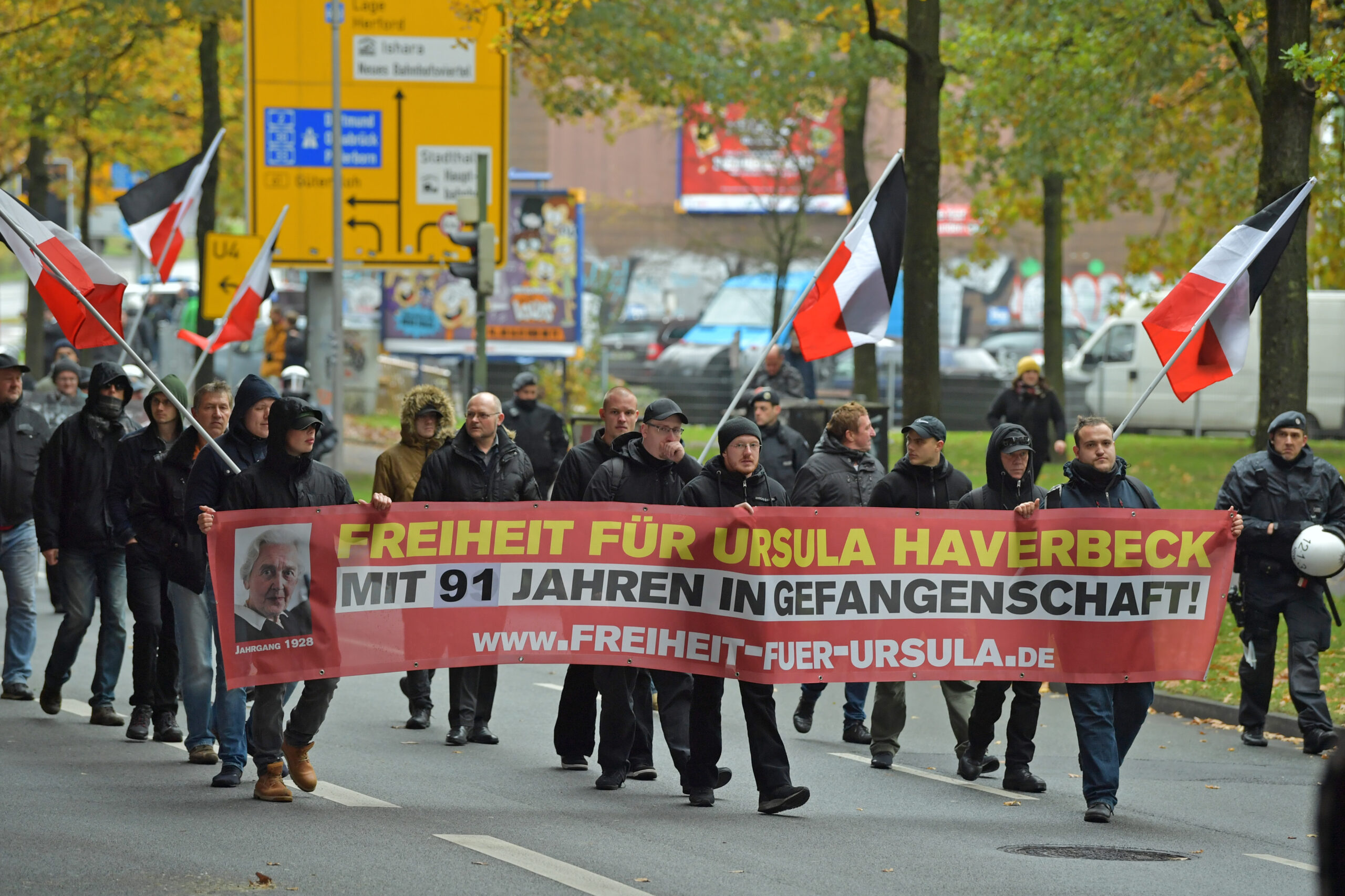
Neo-Nazi demonstration in support of the Holocaust denier Ursula Haverbeck in Bielefeld, 2019
Photo: Thomas F. Starke/Getty Images[/caption]
From the 1970s onwards an organised Holocaust denial took shape internationally. Authors such as Robert Faurisson, Ernst Zündel or David Irving systematically disputed historical facts, calling the gas chambers “inventions” or “propaganda”. This movement operated with pseudo-scientific rhetoric while in fact continuing National Socialist ideology. In Germany the state responded with legal measures – denial of the Holocaust counts as a form of incitement to hatred (Section 130 of the German Criminal Code, StGB) and thus as an attack on the constitutional order.
Yet today Post-Shoah antisemitism expresses itself less often in open denial and more often in relativisation: the singularity of the Shoah is blurred, its historical significance levelled down. Other events – colonialism, Gaza, Ukraine, the Iraq war – are readily equated with Auschwitz in order to shift moral categories. The accusation of a “cult of guilt” and the call to draw a line under the past, for several decades primarily a hallmark of neo-Nazi and far-right Holocaust-denial circles, also came to be used by left-wing and “post-colonial” activists in the course of the anti-Israeli protests following 7 October 2023, for example under the slogan “Free Palestine from German guilt”.
Perpetrator-victim reversal (“The Jews are now doing the same thing as the Nazis”) is one of the most powerful strategies of this relativisation. It turns remembrance into guilt, victims into perpetrators, history into a weapon.
At the same time, right-wing forces repeatedly cultivate the narrative of the Shoah as a marginal event in an otherwise glorious German history and thereby create a dangerous distortion that relativises crimes, plays down perpetration and undermines the foundations of a responsible culture of remembrance. Such narratives not only distort history, they strike at the core of the Federal Republic, which was founded out of responsibility for this crime against humanity and whose democratic order explicitly understands itself as a counter-model to the causes and conditions of the Shoah.
Post-Shoah antisemitism outside post-Nazi societies
In several European countries whose populations took part in the Holocaust, an official or socially dominant victim myth persists to this day, obscuring their own responsibility – for example in Spain, Hungary, France, Poland and parts of the Baltic states, where the nation in question is falsely portrayed as largely blameless.
- In Croatia, for instance, the involvement of the fascist Ustaša movement in the Shoah and in its own extermination camps such as Jasenovac is to this day played down or openly denied in parts of society. Those who point to the involvement of Croatian helpers and perpetrators are frequently branded traitors or enemies of the national self-image.
- Although Spain under Franco adopted National Socialist antisemitic propaganda, turned Jewish refugees away at the border, left opponents of the regime to be murdered in German concentration camps and permitted collaboration, the widespread narrative persists to this day that the country played no part in the Shoah. State historical narratives emphasise neutrality and often ignore the regime’s antisemitic policies; historians and activists who point to the shared responsibility of Spanish authorities or to the entanglement of the Falange are not infrequently defamed.
- In France, the Gaullist myth still dominates in broad sections of society, according to which France as a whole was a country of resistance, while collaboration involved only a small, “renegade” part of the nation. The central role of the Vichy government and of the French police in identifying, registering and deporting more than 70,000 Jews was played down or denied for decades; historians such as Robert Paxton, and organisations that raised these entanglements, long met with fierce social and political resistance.
The necessary engagement with this part of the national history is here, and in further countries, frequently impeded or actively fended off, and people who point to local involvement are quickly regarded as “fouling their own nest”.
Post-Shoah antisemitism outside Europe
In Arab and other non-European contexts, a form of antisemitism has developed since the 1950s that combines Islamist, nationalist and anti-Zionist elements.
After the founding of Israel in 1948, the Shoah was frequently not recognised as a crime against humanity, but interpreted as a “Zionist lie” or as a pretext for colonialism.
- The Hamas Charter (1988) openly quotes the Protocols of the Elders of Zion and describes the Shoah as a manipulative instrument of Jewish power politics.
- In several Arab states – such as Egypt, Syria or Iran – television series and textbooks have been produced in which the Shoah is denied or relativised. Series such as Asch-Schattat (2003) portray Jews as conspirators who themselves “staged” National Socialism.
- In parts of the Arab education system the Shoah is to this day passed over in silence or presented as political propaganda of the West, in order to undermine efforts at normalisation with Israel.
- Iranian state media have repeatedly staged “Holocaust cartoon competitions”; in 2005 President Ahmadinejad called the Shoah a “lie” with which the West protects Israel.
These patterns link denial of the Shoah with anti-Zionist world views: what stands at the centre is not the history of antisemitism but the rejection of Israel as a “colonial product” – a political instrumentalisation of denial.
Challenges for a contemporary culture of remembrance

Relativisation of the Shoah at a demonstration in Berlin, 2023.
Photo: Adam Berry[/caption]
In German society today a growing number of people live without any family connection to National Socialist perpetrators or to the German post-war history of guilt. This plurality confronts the culture of remembrance with new challenges: many younger people, with or without a migration background, do share basic democratic values but grow up without a collective historical consciousness of the Shoah.
Surveys show that awareness of antisemitism as a historical and moral injustice is less pronounced in some groups – not per se out of hostility, but often out of a lack of historical grounding, or the transfer of their own experiences of discrimination onto the Middle East conflict.
At the same time, people from Arab countries of origin or countries shaped by Islam sometimes carry with them narratives in which the Shoah is not at the centre of moral remembrance but is portrayed as a Western or Israeli instrument of power. These interpretations are mostly not deliberate denial, but an expression of a different politics of memory that was itself conveyed by the state in the countries of origin.
For German democracy and education policy this means:
Remembrance of the Shoah must become more inclusive, more contextualised and more dialogical. It must not address national guilt alone, but must make antisemitism comprehensible as a universal, cross-cultural phenomenon.
For Post-Shoah antisemitism is not a German or Western problem alone – it is a global narrative of guilt defensiveness that arises wherever historical responsibility and empathy are refused.
Forms of Post-Shoah antisemitism
This term denotes antisemitism
because of
Auschwitz: it is not the Shoah itself but the memory of it that becomes the target of attack.
People react to guilt, shame or moral overload with rejection – for instance through the call to draw a line under the past, complaints about a “cult of guilt”, or the relativisation of Jewish suffering. Remembrance itself is thus experienced as a provocation and antisemitism becomes a defensive stance towards historical responsibility.
Holocaust denial
The most radical form of falsification of history: the genocide of the European Jews is disputed or turned into its opposite.
Deniers such as Robert Faurisson, David Irving or Ernst Zündel used pseudo-scientific methods to discredit historical evidence. Today denial appears increasingly in digital spaces – as supposed “counter-information”, in the form of memes, videos or conspiracy narratives.
Relativisation and comparative antisemitism
Here the Shoah is not denied, but its specificity is called into question. This frequently happens through equations – for instance between National Socialist crimes and Israeli policy, colonialism or wartime events. This rhetorical strategy shifts moral standards and makes it possible to relativise responsibility or to demonise Israel.
Arab and Islamist cultures of denial
In parts of the Arab world and in Iran the Shoah remains a politically inflammatory subject to this day. Official school textbooks, media or religious authorities pass over or deny the Holocaust, interpret it as a “Zionist invention” or use it to legitimise anti-Israeli policies. Examples are the Iranian “Holocaust cartoon competitions”, the Hamas Charter or television series such as
Asch-Schattat
(Syria, 2003), which spread conspiracy myths and reversal of guilt.
Remembrance in a society of migration
In Germany today many people live without family ties to the National Socialist past.
This makes identification with historical responsibility more difficult – at the same time there is often a deficit of knowledge about the Shoah or about antisemitism as a specific form of hatred. In addition, antisemitic narratives from countries of origin – for example from Arab or post-Soviet contexts – can continue to have an effect within migrant communities. A future-proof culture of remembrance must therefore be inclusive and dialogical: not moralising, but explanatory, connecting and global in its thinking.
Current examples
Speaking to the far-right, conspiracy-ideological outlet AUF1, Götz Kubitschek, ideologue of the extreme right, New Right publisher and confidant of Björn Höcke, declared that Germans must shed the “cult of guilt and the Nazi hysteria” in order to be able to “think freely” – a typical narrative of the extreme right, which defames engagement with the Shoah as a supposed intellectual shackle.
Primary source, AUF1 website:
In 2025 a federal spokeswoman of Linksjugend Solid equated Israel’s war against Hamas in the Gaza Strip with the Shoah. In a video on social media, since deleted, she claims: “That is a genocide. That is a fucking Holocaust. That is the Holocaust!”. What is remarkable is the logical somersault from a “fucking Holocaust” as a term used explicitly for events other than the actual Shoah to the replacement of the historical event by the supposedly “truer” one: “
the
Holocaust”, which is allegedly taking place in Gaza.
Report in WELT:
Participants carried a banner on which “Gaza” was placed in a row with “Namibia” and “Auschwitz” as milestones of German war crimes. This is a relativisation and instrumentalisation of the Shoah: by pointing to German National Socialist and colonial crimes, the accusation of “genocide” with regard to Gaza is to be given legitimacy. What is being denied is therefore not actual German historical guilt; rather, the attempt is made to portray present-day German solidarity with Israel as criminal as well.
Documentation and photo report by the “Linkes Bündnis gegen Antisemitismus” of 19 October 2024:
The QAnon supporter Oliver L. from the Rhein-Pfalz-Kreis ran several large Telegram channels in which he combined the QAnon conspiracy narrative with classic hatred of Jews, denied the Shoah, played down National Socialist crimes and praised Hitler as a redeemer; for this he was given a suspended sentence in 2023 by the Ludwigshafen district court for around 40 counts of incitement to hatred, Holocaust denial and use of National Socialist symbols.
Report in the Frankfurter Rundschau:
Video
This video shows how antisemitism continued in new forms after 1945 – as repression, guilt defensiveness, relativisation and denial of the Shoah, both in Germany and worldwide. It explains why remembrance today has to be conveyed anew in a diverse society and why engagement with the Shoah remains decisive for protecting democratic values.
Sources and further information
Here you will find surveys, broadcasts and literature for further engagement with the topic.
Surveys and documentation
A representative study by the Claims Conference (2025) shows that in Germany 24% of respondents are of the opinion that the number of Jewish victims of the Holocaust has been greatly exaggerated, while at the same time 12% of young adults in Germany stated that they had never heard the terms “Holocaust/Shoa” or were not sure.
In a survey by the EU Agency for Fundamental Rights in 13 EU countries, on average across countries 79% of the Jews surveyed stated that they had personally experienced Holocaust denial, trivialisation or distortion; 71% encountered the accusation that Jews exploit the “Holocaust victim narrative”.
FRA, Jewish People’s Experiences and Perceptions of Antisemitism, Vienna 2024
PDF download:
Amadeu Antonio Stiftung (2024): Angriffe auf Erinnerung, das rote Dreieck und Gewalt. Spotlights der Chronik antisemitischer Vorfälle.
VAD – Verein für Aufklärung und Demokratie e.V. and Recherche- und Informationsstelle Antisemitismus Bayern (eds.) (2024): „Free Palestine from German guilt“? Israelbezogener Antisemitismus in Bayern nach dem 7. Oktober. Download:
Videos
of 25 January 2024 with Lars Rensmann and Ingo Elbe on the “Historikerstreit 2.0”.
On YouTube:
Recording of the event „Berlin – Europäische Erinnerung?/ Berlin: European Memory?“ with Ljiljana Radonić and Katja Makhotina as part of the European event series „Facing Nazi Crimes: European Perspectives after 1945“ on 8 October 2025 at the Deutsches Historisches Museum.
On YouTube:
Further reading
Elbe, Ingo (2024): Antisemitismus und postkoloniale Theorie. Der »progressive« Angriff auf Israel, Judentum und Holocausterinnerung. Berlin: Edition Tiamat.
Elbe, Ingo (n.d.): Die „Verschwörung der Asche von Zion“. Anmerkungen zum postkolonialen Angriff auf die Singularität des Holocaust. PDF at
Friedländer, Saul (2007): Das Dritte Reich und die Juden. Die Jahre der Vernichtung.
Munich: C.H. Beck.
(authoritative for the debate on singularity)
Goodman, David G. / Miyazawa, Masanori (1995): Jews in the Japanese Mind. The History and Uses of a Cultural Stereotype. New York: Free Press.
Grigat, Stephan (2006): Postnazismus und Antisemitismus. Freiburg: ça ira.
Grigat, Stephan / Porst, Jonas / Zareski, Katja (eds.) (2023): Erinnern als höchste Form des Vergessens? (Um-)Deutungen des Holocaust und der „Historikerstreit 2.0“. Berlin: Verbrecher Verlag.
Grigat, Stephan (ed.): Kritik des Antisemitismus in der Gegenwart. Erscheinungsformen – Theorien – Bekämpfung. Baden-Baden: Nomos-Verlag.
Herf, Jeffrey (2006): Der Judenstaat im arabischen Antizionismus. Der Holocaust und die politische Kultur der arabischen Welt. Berlin: Hentrich & Hentrich.
Klävers, Steffen (2019): Decolonizing Auschwitz? Komparativ-postkoloniale Ansätze in der Holocaustforschung. Berlin: De Gruyter.
Kovács, András / Weissmann, Miklós (eds.) (2018): The Holocaust in Hungary: Seventy Years Later. Budapest/New York: CEU Press.
Kuretsidis-Haider, Claudia/Garscha, Winfried R. (1998): Keine “Abrechnung”. NS-Verbrechen, Justiz und Gesellschaft in Europa nach 1945. Leipzig/Wien: n.p.
Lohl, Jan/Moré, Angela (2014): Unbewusste Erbschaften des Nationalsozialismus. Psychoanalytische, sozialpsychologische und historische Studien. Gießen: Psychosozial-Verlag.
Radonić, Ljiljana (2012): „Die Europäisierung der Erinnerung nach dem Holocaust.“ In:
Transit. Europäische Revue
, No. 43. Vienna.
Radonić, Ljiljana (2013): „Postsozialistische Erinnerungskulturen und der Holocaust: Zur Europäisierung nationaler Narrative.“ In:
Österreichische Zeitschrift für Politikwissenschaft
, 42(1). Vienna.
Rensmann, Lars (2017): The Politics of Unreason. The Frankfurt School and the Origins of Modern Antisemitism. Albany: SUNY Press.
(central chapters on Post-Shoah antisemitism and the politics of memory)
Rensmann, Lars (2020): „Gegenaufklärung: Antisemitismus, Antiliberalismus und Geschichtsrevisionismus.“ In:
Mittelweg 36
, 5/2020. Hamburg: HIS Institute.
Richter, Salome et al. (2024): Antisemitismus in der postnazistischen Migrationsgesellschaft. Eine interdisziplinäre Bestandsaufnahme. Opladen et al.: Verlag Barbara Budrich.
Weiß, Volker (2021): „Schuldkult“ und „Schuldkolonie“. Tradition und Ziele des aktuellen Geschichtsrevisionismus. In:
Reflexionen
, Stiftung Gedenkstätten Buchenwald und Mittelbau-Dora. Online:
Wodak, Ruth (2015): The Politics of Fear. What Right-Wing Populist Discourses Mean. London: Sage.
(sections on the politics of memory and the relativisation of right-wing narratives)