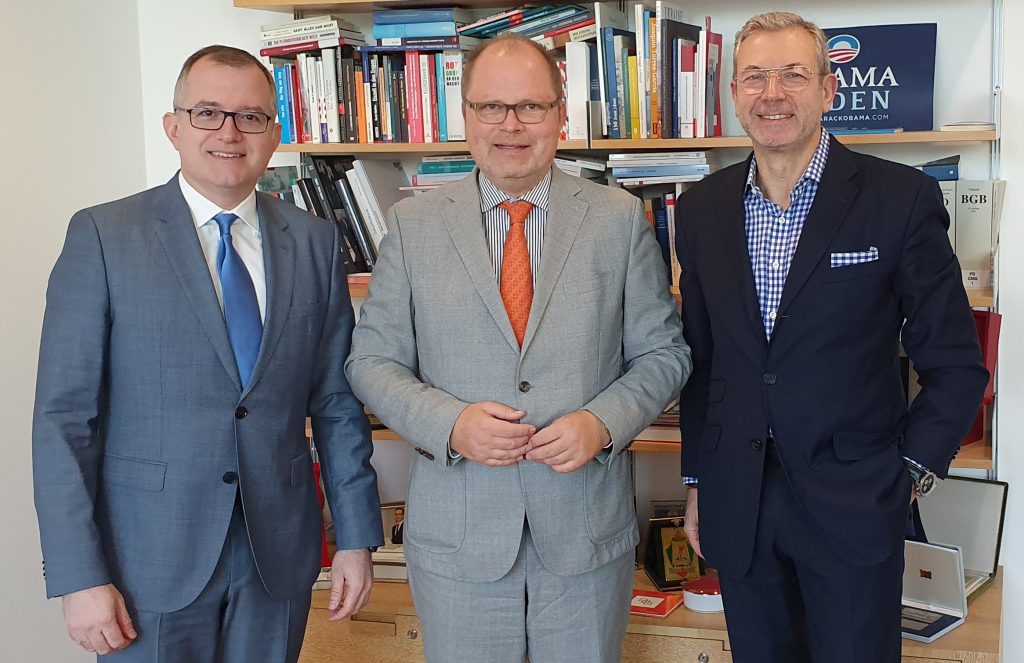
In this context, one of the topics in our conversation between Christian Lange (SPD), State Secretary at the Federal Ministry of Justice, our member Nathan Gelbart and Elio Adler was Section 46(2) StGB. Since 2015 it has expressly named “racist, xenophobic or other motives that despise human beings” as motives and aims to be taken into account when sentencing. This makes it possible to punish offences more severely if, for example, they have an antisemitic background or are directed against the free and democratic form of living together. Mr Lange said on this: “There is a difference between knocking a straw hat off someone’s head and quite deliberately knocking off a kippah. Section 46(2) StGB makes itself felt in sentencing.”
So that consistent use is made of this “FDGO shield”, the authorities’ sensitivity to taking the background of offences into account in sentencing must be fostered. To that end, further training has been offered in recent years for the police, public prosecutors’ offices, judges and lawyers. The Deutsche Richterakademie, for example, regularly offers further training events which deal, among other things, with questions of political extremism and antisemitism as a challenge to society and the judiciary. The Federal Ministry of Justice and Consumer Protection has also carried out a project with the Deutsches Institut für Menschenrechte on the subject of “Racism and human rights: strengthening the criminal justice system”.
Nevertheless, there is further need for action here: in order to be able to provide evidence in court that makes the application of this provision possible, additional investigative work is necessary, and that in turn requires expertise and staff resources.
Politics, too, could communicate the possibilities of this law more strongly.
We thank State Secretary Lange for the friendly and constructive conversation.