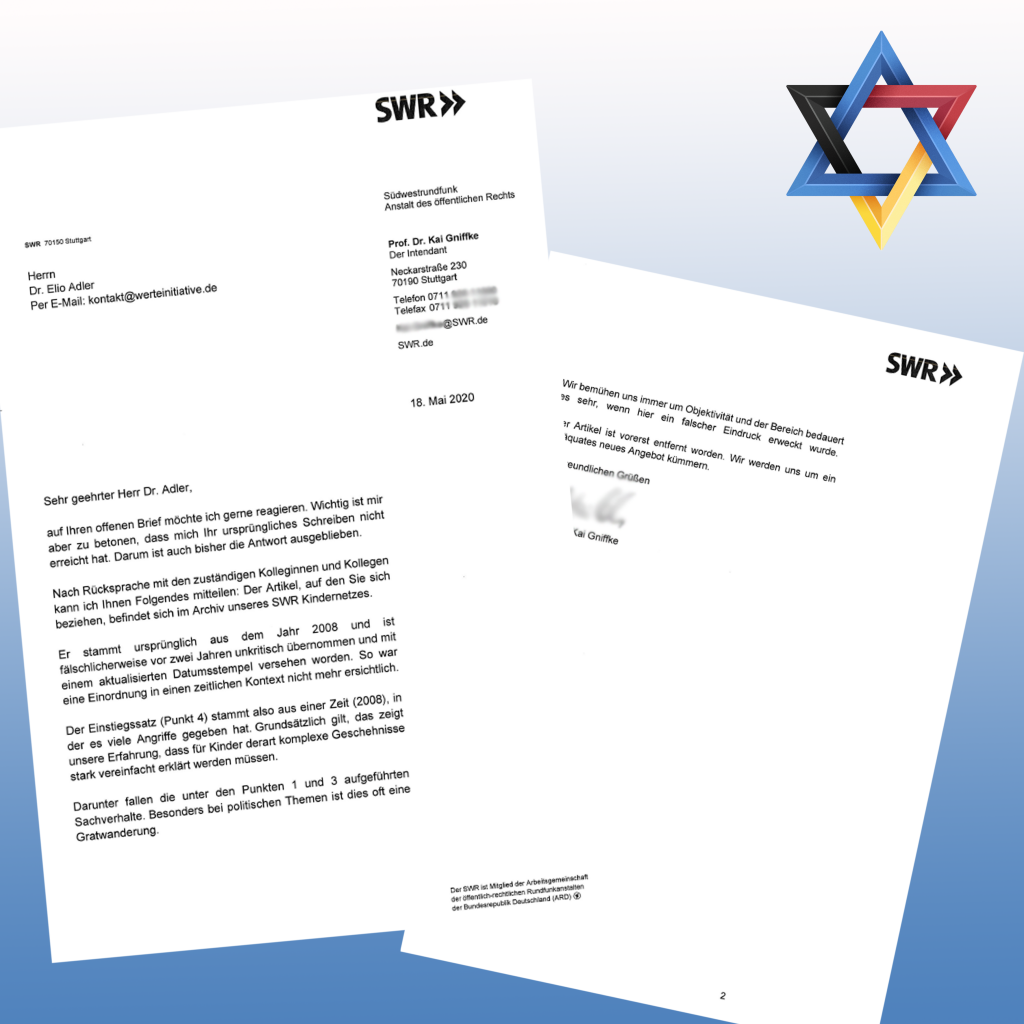

The director-general of SWR, Prof. Kai Gniffke, has reacted very positively. The report in question is offline and is being revised. Good, and thank you!Dear Dr Adler,
I would like to respond to your open letter. It is important to me, however, to emphasise that your original letter did not reach me. That is also why an answer has been lacking so far.
After consulting the responsible colleagues, I can inform you of the following: the article you refer to is in the archive of our SWR Kindernetz.
It originally dates from 2008 and was wrongly taken over uncritically two years ago and given an updated date stamp. As a result, a classification within a temporal context was no longer discernible.
The opening sentence (point 4) thus dates from a time (2008) in which there were many attacks. As a matter of principle – our experience shows this – events of such complexity have to be explained to children in a strongly simplified way.
This applies to the matters listed under points 1 and 3. Especially with political topics this is often a balancing act.
We always strive for objectivity, and the department very much regrets it if a false impression was created here.
The article has been removed for the time being. We will see to an adequate new offering.
Yours sincerely
Prof. Dr Kai GniffkeDear Prof. Dr Kai Gniffke,
we, WerteInitiative – jüdisch-deutsche Positionen, are writing to you on the occasion of the article „Ein Land braucht Frieden“, which appeared in the SWR-Kindernetz and is intended to introduce the relationship between Israel and Palestine. (https://www.kindernetz.de/infonetz/politik/palaestina/-/id=441582/nid=441582/did=118840/tq2geq/index.html).
Since 2014 WerteInitiative has established itself as a civil-society Jewish voice in Germany. We set out to secure the future of Jewish life in Germany. We therefore work for the strengthening of the values of the free democratic basic order from a Jewish perspective. We do this by promoting the values-based political, social and media discourse, civic Jewish engagement in Germany and the German-Israeli relationship. For further information we recommend visiting our website: https://werteinitiative.de//.
We live in a time in which social divides are becoming deeper and German Jews are feeling antisemitism ever more strongly. A substantial part of it consists of Israel-related antisemitism. It demonises and delegitimises Israel and judges its state actions, in contrast to those of the other parties to the conflict, by double standards.
That is why a mindful approach to the complex of topics around the conflict between Israelis and Palestinian Arabs is very important to us, particularly in educational communication. As important as it is to take up this subject, the subject must not be inappropriately abbreviated and important patterns of explanation must not be passed over in silence.To the website:
1.
The author, Ms Amann, claims to explain how „this crisis came about at all“:
„The dispute between Israelis and Palestinians is about exactly where the borders should run.“
This statement contains a massive distortion: if the simple course of the border were the problem of the so-called „Middle East conflict“, there would have been a state called „Palestine“ since 1948. The Arab League did not reject the UN partition plan because of the course of the border. It rejected the founding of the Israeli state in its entirety and declared a war of annihilation on Israel. Let us also recall, for example, the „three noes“ of the so-called „Khartoum Resolution“: „NO peace with Israel – NO recognition of Israel – NO negotiations with Israel“.
The founding of an Arab-Palestinian state did not fail because of Israel. Essential to this is also the disunity of the Palestinian Arabs: Fatah in the West Bank, Hamas in Gaza, the refugees in the neighbouring states and finally the Arab citizens of Israel.
With which of these groups is Israel supposed to negotiate with legal certainty?
2.
A further problem: according to the author,
„radicals on both sides (…) want the whole territory for their group.“
Here things are equated that are not equal. On the one side a democratic government, a state under the rule of law. On the other side numerous splintered groups which each, on their own, make their own
claims. The demand for „the whole territory“ for Israel is made in Israel by only a minority, and in order to assert its opinion it does not fight against the Palestinian Arabs but, within the framework of democratic discourse, against other Israeli groups that hold a different position here.
On one of the other sides of the conflict stands Hamas, a terrorist organisation. To this day it demands the complete annihilation of Israel and kills those of its compatriots who raise their voices against it. Furthermore there is Fatah in the West Bank, which cultivates a so-called martyr cult in an appalling manner, names schools and streets after killed terrorists, pays terror pensions and to this day fantasises about a „Palestine from the Jordan to the Mediterranean“. Its battle cry is still today: „From the river to the sea – Palestine will be free!”.
3.
This battle cry, which leaves not a square centimetre of room for a Jewish state (cf. Ms Amann’s „dispute about borders“), is then also adopted one-to-one by your author and reproduced as fact
:
„Palestine is small. From the Mediterranean to the Jordan, the border with the neighbouring country Jordan,…“
4.
Another aspect is raised by this statement:
„News from the Middle East is rarely good news: it is about failed peace plans, war, hatred and violence.“
Teaching this region exclusively as a crisis region contributes to it remaining one, in the sense of a „self-fulfilling prophecy“. Your readers, or better the learning children, see the region through these spectacles. There would be at least positive aspects worth mentioning, which could be a point of connection for hope and prospects for children: there were and are indeed
peace negotiations that led to a positive result. As an example, let only the peace treaties between Israel and Jordan or Israel and Egypt be mentioned. Joint
projects, friendships, culture, cuisine and so on. We Jewish Germans experience how great the power of the hate-filled narratives is that penetrate here from the Middle East. Please do not underestimate a further problem of your text: what, for example, do children of Palestinian-Arab origin who live in Germany say to their family members in the Middle East? Does your text allow it to have a calming effect from outside, or does it tempt them to fuel the conflict by adopting a one-sided narrative?
The fundamental problem in this article is its tendentiousness. It serves a one-sided view of the conflict between Israelis and Palestinian Arabs and is apt to inflame
both the conflict on the ground and the antisemitism experienced by us in Germany.
Such an important educational project and medium as the „Kindernetz“ should – for all the complexity of the subject and the brevity of presentation nevertheless required for children – encourage the young
generation, precisely in today’s times of visible antisemitism, to form their own opinion through balanced information.
We therefore consider a revision of the current presentation to be urgently necessary. Our members, who drew our attention to your page, would like to learn how you will proceed with regard to the passages addressed here
in the text. We will gladly publish not only this letter on its own but, in a timely manner, together with a positive reaction.
Yours sincerely
Dr Elio Adler
– Chairman -1.5.2020:
As we have unfortunately received no reply from Professor Gniffke, we can only publish our letter.